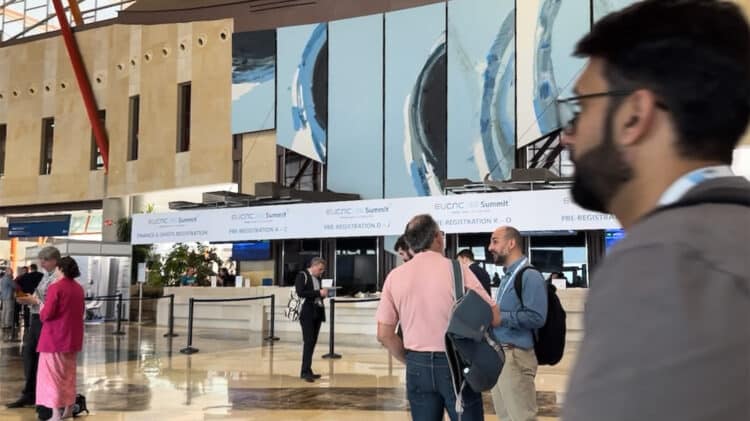
The questions have evolved – 6G Flagship at EuCNC & 6G Summit 2026
Every new generation of mobile network has sold itself on the same thing: speed. 3G brought the mobile internet, 4G brought video, 5G promised to connect machines as well as people, and each step came with a bigger number to point at. The pitch wrote itself.
This June in Málaga, at EuCNC & 6G Summit, Europe’s main research conference for mobile networks, that number had quietly stopped being the point. More than 1,200 engineers, academics and company representatives spent four days on questions that are harder to answer and harder to sell. Can a network be built to survive shocks, not just to run fast? Can the next generation, 6G, be made sustainable without pricing itself out of reach? And what will a world of machines talking to machines demand of the signals in the air?
6G is still years away. The international standard that will define it is due at the end of 2028, and nothing carrying the name will reach a phone before then. But the shape of it is being argued over now, in rooms like these. On each of the week’s hardest questions, the University of Oulu‘s 6G Flagship, a Finnish research programme set up to develop the foundations of 6G, had someone on the stage.
Sustainability, and who pays for it
The sustainability question got its sharpest hearing on the Friday, in the closing panel on sustainability in 6G business, chaired by Marja Matinmikko-Blue. It put Nokia and Orange together with Henning Breuer from the Media University of Applied Sciences around a single problem: can sustainability be turned into a business rather than carried as a cost?
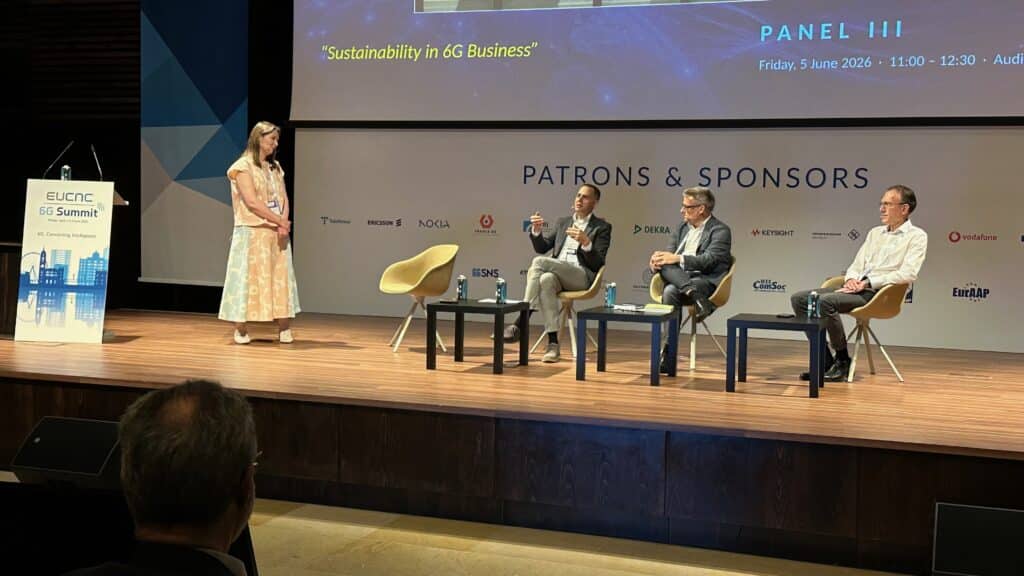
The answers ranged from selling sustainability as a service to building networks around the value a user actually gets rather than the volume of traffic they shift. Regulation came up as both burden and lever. The AI Act, energy rules, and digital product passports add to reporting work, the panel agreed, but they also lay a foundation that new business can be built on. The operators pushed back with a hard truth of their own. Every mobile generation still has to give people something they can feel, or the promises ring hollow.
Behind that debate sat a body of research, presented separately across the week. Seppo Yrjölä, a professor who studies the economics of technology, presented three papers built on one claim. Resilience in 6G, the ability to keep working when something goes wrong, cannot come from engineering alone. It needs business models that make the investment worth making, and rules that hold together across borders.
Two of the papers ran on the Wednesday, in the track on network visions, one on business models for resilience and one on whether governments can legitimately require networks to be resilient at all. The third, on the technical groundwork for resilient local 6G, came on Friday.
From the main stage on Thursday, Carmen Mas-Machuca of the Bundeswehr University Munich called telecom networks critical infrastructure and warned that planning can no longer chase capacity alone. Yrjölä’s papers asked the obvious follow-up. Who pays for the robustness she wants?
What the machines will ask
If sustainability was one current running through the week, artificial intelligence was the other, and the two kept meeting. The keynote talks sketched a near future of humanoid robots, self-driving cars already loose in cities, and glasses that record everything their wearer sees. All of it leans on the network.
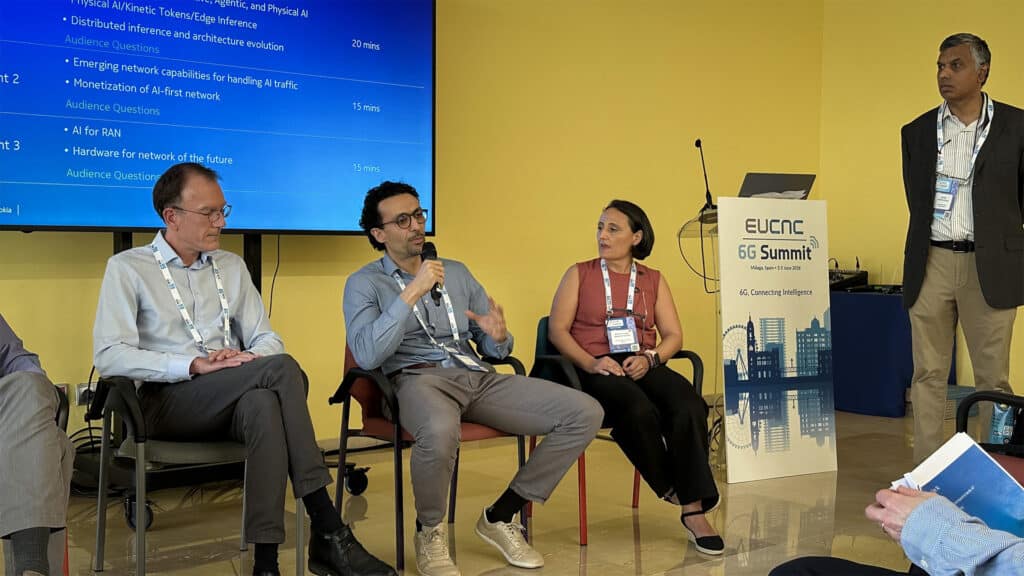
Mehdi Bennis, one of the most cited researchers in his field, used the Wednesday panel on networks in the AI era to sharpen what that future will demand. The chatbots we know sit in distant data centres and answer in text. Physical AI is different in kind. It senses, reasons and acts in the world, then closes the loop by moving something real. That puts it where machine learning meets control theory, the older engineering discipline of keeping moving systems stable, which AI has dragged back into the light.
Bennis kept returning to one analogy, the kinetic token. A language model writes by stringing together tokens, small reusable pieces of text it can recombine into any sentence. A robot, he suggested, could move the same way, building its actions out of small standard movements. Learn that vocabulary of motor skills once, and it could be composed into any task and carried from one machine to another, the way a fixed set of words makes endless sentences. The idea is appealing and far from solved. Two problems stand in the way. The first is getting those separate movements to chain into smooth, continuous motion. The second is safety. A machine that acts in the physical world cannot simply play the odds the way a chatbot does. It has to be sure, checking an action before it takes it.
The physical layer still has to work
Every one of those ambitions depends on the radio actually working, and at frequencies where it would rather not. This is the physical layer, the bottom of the network where signals travel through the air, and it is where Oulu does some of its most literal frontier work.
Marko E. Leinonen spoke in Tuesday’s terahertz workshop on what the millimetre-wave and sub-terahertz bands can offer 6G. These are very high radio frequencies, far above anything a phone uses today. They can carry enormous amounts of data but travel badly, blocked by walls, by rain, even by a hand. In the physical-layer sessions Leinonen showed that you can still locate a target accurately, both its direction and its distance, using the crude, power-frugal antenna hardware that real systems are stuck with. The workshop was largely an Oulu and Japanese affair, the fourth run with the Tokyo University of Agriculture and Technology, with Nuutti Tervo chairing its first session and Joonas Kokkoniemi co-organising the event and chairing the second.
The same instinct, making a stubborn physical layer usable, ran through the work on MIMO, the antenna arrays that send several streams of data at once by using many small antennas together. Markku Juntti joined a Thursday panel on very large MIMO arrays and intelligent sensing. Antti Tölli presented a way for such a system to report the state of the radio channel back to the transmitter using a compact code rather than a full description, saving bandwidth without losing much accuracy, work carried out with Nokia Bell Labs.
Theory you can touch
Down on the exhibition floor, the arguments turned into things a visitor could prod.
The 6G-VERSUS team, Antti Pauanne, Juho Markkula, Hamid Malik and Sanna Tuomela, showed a base station that feeds itself: a radio, built to open industry standards, modelled to run all year on solar, wind and hydrogen. Its energy budget shifted in front of you as visitors changed the weather on it.
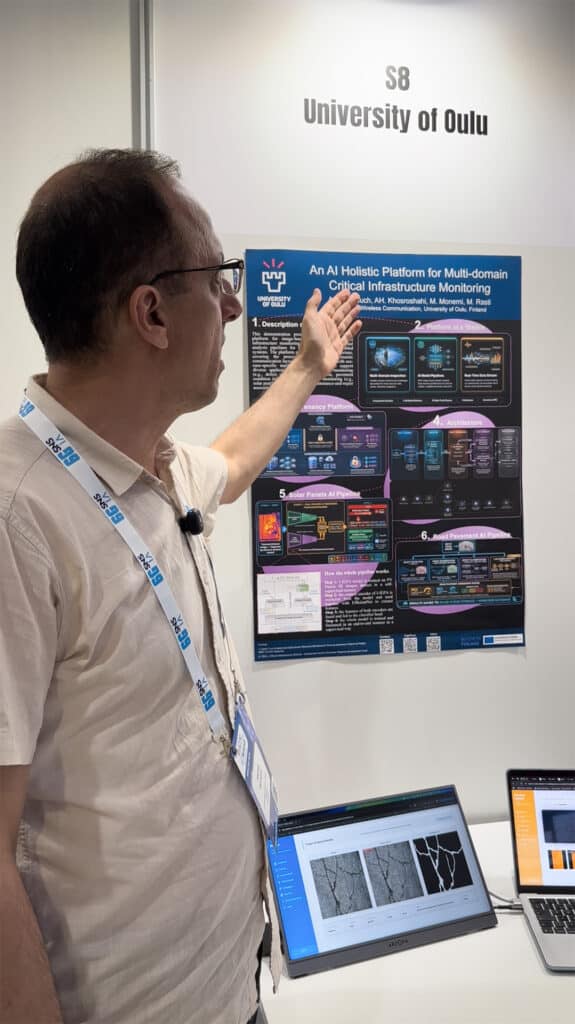
Nearby, Abdelhak Kharbouch, Amirhossein Khosroshahi, Mehdi Rasti and Mehdi Monemi showed an AI platform that inspects critical infrastructure from images, spotting cracks in road surfaces and faults in solar panels, from the DigiPave and TEKU projects, so repairs can be planned before something fails.
At the 6GReMade stand, Tervo and Ankit Regmi showed what engineers call integrated sensing and communication: using one radio signal both to carry data and to read the world around it, radar and a network in the same beam. They aimed a 300 GHz link and a camera at a closed box and worked out the object inside it from the way it bent the signal.
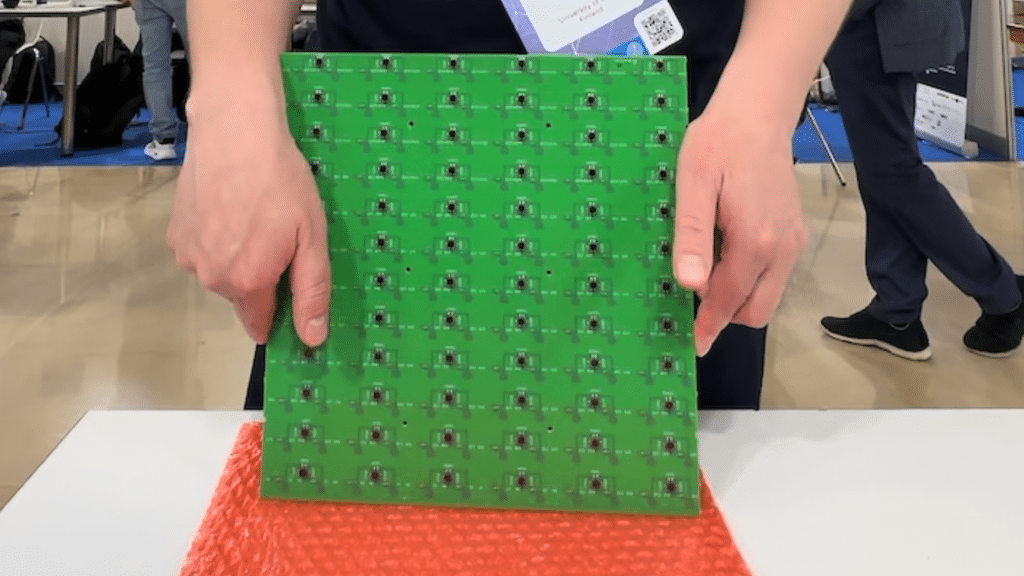
At INTEGRATE, Tung D. Phan, with Nhan Nguyen, Ping Jack Soh and Markku Juntti, turned a reconfigurable intelligent surface, a flat panel of tiny elements that steers radio waves like an adjustable mirror, into a low-power base station for the 6 GHz band. A machine-learning algorithm guessed where a user was standing so the surface could aim at them with almost no scanning.
Recognition, and a handover
The week brought formal recognition too. At the gala dinner on 4 June, ETSI, the European telecoms standards body, announced the winners of the first edition of its Research and Innovation Awards. Professor Matti Hämäläinen took the Individual Researcher award for years spent standardising wireless body area networks, the small networks of sensors worn on or in the body for health monitoring, through ETSI’s SmartBAN committee, where he represents the University of Oulu. Hexa-X-II, the European 6G project in which University of Oulu is a partner, was one of two winners in the collaborative-project category, recognised for its work on sustainability standards.
There was a longer handover too. From September the EuCNC Steering Committee, which runs the conference, passes to Professor Markku Juntti, and in 2027 the event itself moves to Dublin. Dublin was, in a sense, already on stage this year: one of Thursday’s keynotes came from Marco Ruffini of Trinity College Dublin, who described optical networks learning to sense their own surroundings, reading the faint changes of light inside a buried fibre to pick up anything from an earthquake to a passing ship.
The international 6G standard is due to be finished by the end of 2028. Almost everything that filled the rooms in Málaga, the resilience, the sustainability, the machines that will lean on the network, points at the world that standard will describe. The questions have evolved. On the week’s evidence, 6G Flagship is asking the right ones.
Where to find the work
The researchers named here are a selection. Across the four days, more than two dozen 6G Flagship and University of Oulu people took part in the EuCNC & 6G Summit, in full the European Conference on Networks and Communications and the 6G Summit, through workshops, paper tracks, poster sessions, panels and the demo floor. The full line-up, with a link to each session, is available in the 6G Flagship event calendar.
The conference programme is on the EuCNC & 6G Summit website, and the papers will appear in the proceedings on IEEE Xplore.