Mining for proof
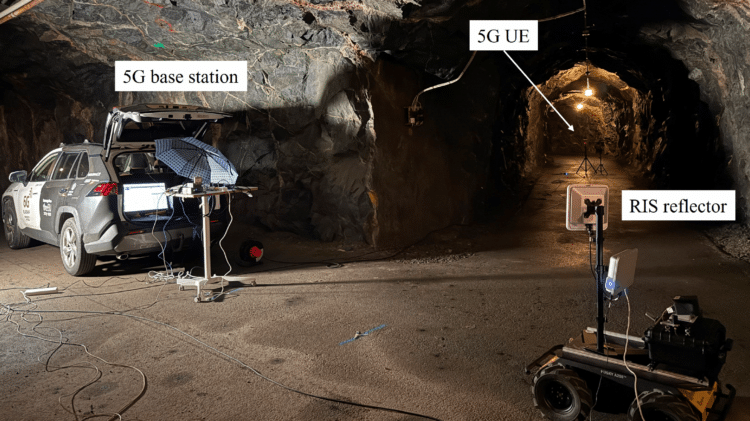
Halfway through the underground tunnels of Mjölkuddsberget in Luleå, northern Sweden, a chequered umbrella shelters a laptop and a 5G millimetre-wave base station from water dripping off the rock. Cables snake across a wet stone floor. The boot of a 6G Flagship test car holds part of the transmitter. Twenty-two metres away, around a bend in a side tunnel, a small wheeled rover carries a reconfigurable intelligent surface, a flat panel made of programmable reflecting elements. The base station fires a 28 GHz signal at the panel. The panel bounces it round the corner. A receiver at the far end registers the signal at full strength.
Without the panel, the signal dies four metres around the corner. With it, the side tunnel keeps coverage for at least twenty-two. That difference, captured in real measurements, is one of three pieces of evidence Oulu researchers will present on Friday morning at EuCNC and 6G Summit in Málaga. Each tackles the same underlying problem from a different layer.
For half a decade the 6G research community has produced ambitious visions and elegant mathematics. What it has produced less of is demonstrated proof that the visions and the mathematics survive contact with the world they will have to operate in. The three Friday papers, between them, offer three kinds of proof: empirical, algorithmic, and structural.
What happens when you take the theory underground?
Reconfigurable intelligent surfaces, or RIS, are panels of programmable elements that reshape radio waves in the air. They have been one of the most-hyped enablers of 6G for years. Simulations promised everything: better coverage, lower power, smarter beamforming. What has been thinner on the ground is actual deployment evidence in difficult environments.
Klaus Nevala, working with Sohaib Bin Shahid, Mina Tavangar, Duccio Delfini, Antti Pauanne and Marko E. Leinonen from Oulu, and Achilleas Seisa, Michael Nilsson and George Nikolakopoulos from Luleå University of Technology, set out to change that. The team installed a standalone 5G millimetre-wave network inside an underground mine, added a RIS at the intersection of two tunnels, and measured what actually happened. The team believes this was the first such deployment of a 28 GHz standalone network with a RIS inside an operating mine environment.
The findings matter beyond mining. The mine is, in effect, a stress test. Millimetre-wave signals attenuate fast around corners, and in confined tunnel geometries the problem is sharper than anywhere else. Their results show that with the RIS programmed to reflect the signal at the correct angle, cell coverage in the side tunnel grew from four metres to twenty-two metres. The signal-to-interference-and-noise ratio held its quality. A theoretical prediction based on radar cross-section analysis matched the measurements to within an average of one decibel. The maths and the hardware agreed, in the kind of environment where they often do not.
Mining is one obvious application. Autonomous vehicles, remote operations, high-throughput sensor networks underground all need reliable wireless that current systems struggle to deliver around tunnel corners. Beyond mining, the same physics applies in any setting where signals have to bend around obstacles: industrial sites, dense urban environments, complex factory floors. The work carried out at Mjölkuddsberget is the kind of empirical anchor 6G needs more of.
Making one smart surface serve many real users
A RIS that works for one user in a tunnel is one thing. A RIS that works for many users at the same time, each wanting different data, is another problem entirely. This is what Pasan Karunasena, with Nandana Rajatheva and Matti Latva-aho at Oulu’s Centre for Wireless Communications, takes up.
Most existing RIS designs configure the whole surface as a single beamforming unit, optimising one set of phase shifts to serve every connected user simultaneously. That works passably when users are clustered together with similar needs. It fails when users are spatially separated and want different things, which is what real multi-user scenarios look like.
Karunasena’s team proposes splitting the RIS into dedicated sub-units, each serving a different user, and works out the joint optimisation problem that follows. They explore two ways of allocating the sub-units: equal partitioning, and a smarter scheme that takes channel state information into account. The team also takes on a more exotic capability called reflection modulation, where the surface itself encodes extra information through its activation pattern, on top of simply reflecting incoming signals. The result is a framework that lets one RIS deliver custom data to multiple users at the same time, with improved convergence and lower error rates than the standard approach.
The Karunasena work is the algorithmic proof: the maths that lets the kind of hardware Nevala just put in a mine actually serve many users in a real deployment.
The technologies are already choosing the business
If Nevala and Karunasena are working at the physical and algorithmic layers, Seppo Yrjölä and colleagues are doing something different. With Arturo Basaure, Marja Matinmikko-Blue and Petri Ahokangas, Yrjölä asks what the cumulative effect of all these technology choices is on the business shape of a future 6G network. The paper, the third in his EuCNC trio after the two papers he presented at the EuCNC and 6G Summit on Wednesday, takes the longest view.
The team starts with the 6G Flagship 15th White Paper on resilience, drawn from more than fifty experts across academia, industry and government. From it they extract a long list of enabling technologies: RIS, sub-networks, distributed massive MIMO, edge cloud continuum, integrated sensing and communications, AI-RAN, post-quantum cryptography, network slicing, distributed ledgers, smart contracts, many more. Then they do something the engineering literature rarely does. They map each technology onto two grids at once: the value layers of a digital business (connection, computing, content, context, commerce) and four distinct platform archetypes, ranging from tightly governed solution platforms through consortium-based shared infrastructure to fully decentralised autonomous networks.
The output is a matrix that reads, on the surface, like a taxonomy. Read more carefully, it is an argument. Each technology choice quietly tilts the network toward one business archetype rather than another.
Build with RIS and edge cloud, and you are leaning toward a consortium platform across industries. Build with smart contracts and distributed ledgers, and you are leaning toward decentralised autonomy. Build with SLA-aware allocation and trusted execution environments, and you are leaning toward a solution-enabler platform serving specific industries.
In other words, the technologies are not neutral. They are already deciding what kind of business 6G can be. Engineers who are not thinking about that are, in effect, letting the architecture decide for them.
This is the structural proof. Not something that works in a mine, not an algorithm that solves a problem, but a map of how the pieces fit together and what that fitting commits you to. For policymakers, operators and standards bodies trying to make sense of 6G commercial future, the matrix is a navigation chart.
Three layers, one question
The three papers, taken together, point at a single question that the field is going to have to answer in the next few years. 6G has been described, white-papered, theorised, and is now being standardised. The hard part now is showing, in difficult environments, with real users and real business commitments, that any of it works as intended.
Friday’s papers from the University of Oulu offer three slices of that proof. Hardware in a mine. Algorithms for many users. A map of what the technology choices commit operators to. The harder question is how much more of 6G can be moved from blueprint to evidence before the standards are written.
Where to listen on Friday 5 June
Klaus Nevala and Pasan Karunasena both present in session PHY7 (Reconfigurable Intelligent Surfaces), 09:00 to 10:30, room Sala 1 (1st floor). Seppo Yrjölä presents in the parallel MULTI session at 09:00 in room M12. The two sessions clash, so attendees with an interest in both will need to choose.
Marja Matinmikko-Blue, who co-authored Yrjölä’s paper, also moderates a panel later in the day, and is a good route in for follow-up questions on the regulatory and business angles. If you are at the conference, come along, ask hard questions, and meet our researchers in person.
The full 6G Flagship menu at EuCNC and 6G Summit is available in our event calendar.