Two Finland–US projects study drone-borne radio links and networks that sense their surroundings
When a storm takes down a fibre line or a disaster cuts off a region, rebuilding the connection can take days. Two new projects at the University of Oulu, both run with partners in the United States, examine how wireless networks can continue operating and track their surroundings when conditions change without warning.
Both projects were funded in the same joint call of the US National Science Foundation (NSF) and the Research Council of Finland, under the NSF’s VINES programme.
Fibre-like links from the air
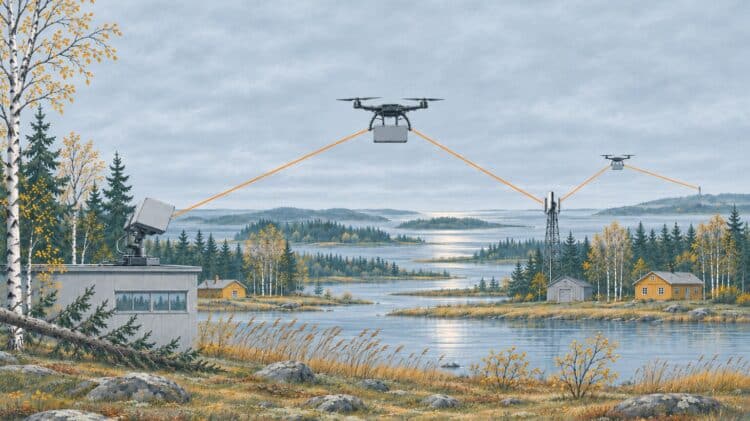
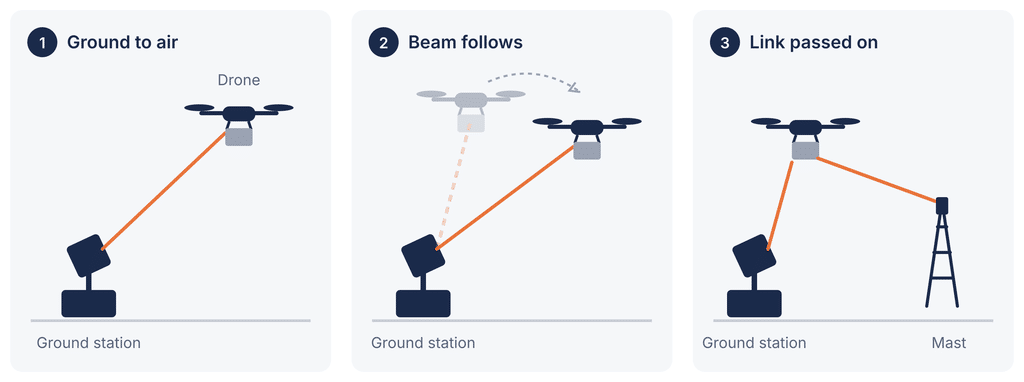
The ERA-THz project (Elevating Resilience in Aerial Platform Integrated THz Backhaul) studies high-capacity radio links operating above 100 GHz carried by drones, balloons, and other aerial platforms. Such links can approach fibre data rates and can take only hours to set up. This makes them extremely useful after natural disasters, at temporary events or in remote operations.
The part that is not so straightforward is keeping them stable. A drone moves, weather and the atmosphere disturb the signal, obstacles block it, and interference can be deliberate. ERA-THz seeks ways to adapt to these conditions so the network can maintain service without constant human management.
The Oulu team, led by Adjunct Professor Joonas Kokkoniemi, measures how long-distance drone links behave at sub-terahertz frequencies, both in the laboratory and in real environments. The team also develops beamforming methods that maintain high link quality as the drones move, and network-level optimisation that reacts in real time when resources suddenly disappear or when a temporary drone network brings extra capacity to an area.
“Drones, balloons, and aircraft can bring fibre-like capacity to a disaster area within hours, but only if the link survives movement, weather, blockage, and deliberate interference. We want networks that adapt to those conditions on their own and heal themselves when a link drops,” says Kokkoniemi.
The US partner is Oklahoma State University, where the work is led by Assistant Professor Shahriar Shahabuddin and Associate Professor John O’Hara. The project runs from October 2026 to September 2029. The NSF funds the US side with USD 700,000. The Finnish side has a budget of EUR 740,000, 70% of it from the Research Council of Finland.
The ERA-THz partners plan to publish their measurement data and software tools openly, according to the NSF’s project award summary.
Networks that sense the space around them
The second project, SmartSpaces (Novel Spatial Awareness Services to Enable New Verticals), asks how a wireless network could answer questions about what’s happening around it. Led in Oulu by Associate Professor Onel Alcaraz López, it develops spatial awareness as a new network service. A phone or a robot in a building could ask the network what is happening at a particular spot and get an answer. The approach relies on integrated sensing and communication (ISAC), in which the same radio signals carry data and gather information about the environment.
Cameras could do some of this, but radio works in the dark and through smoke, and it can sense what is out of sight. The project focuses on indoor spaces, from single rooms and homes to factories, airports, shopping centres, and office buildings.
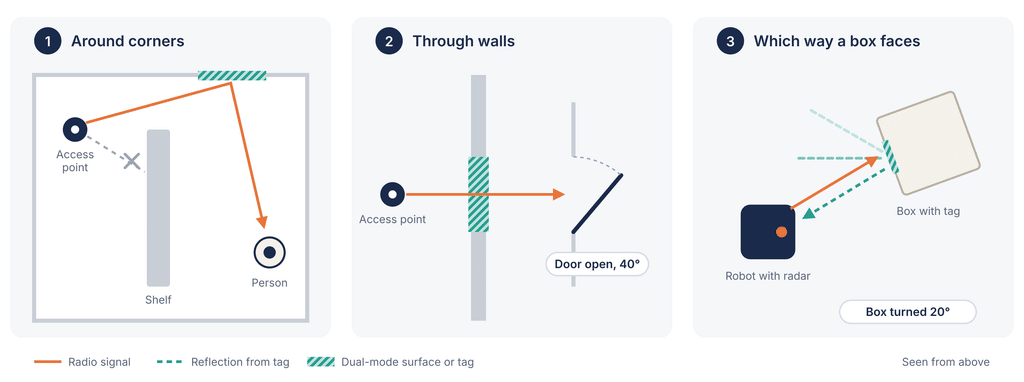
The team uses a warehouse, where people and robots work side by side, as an example of what the system could do. An access point in the ceiling provides data and senses the aisles simultaneously. When a shelf blocks its direct view, a dual-mode surface on the wall, which can either reflect radio signals or let them pass through, lets it sense around the corner and through the wall, for example, to tell whether a door is open. Small passive tags on boxes, called iridescent tags, reflect radar signals differently in each direction, so a robot’s radar can work out which way a box is facing before picking it up. Another kind of tag, which combines radio and ultrasound, can reveal what a package contains, such as whether it holds liquid and how full it is.
In Oulu, the team develops ISAC solutions, the iridescent tags, and the signal processing behind them. The researchers also design ways to query a space without disturbing ordinary data traffic, and to schedule those queries when many devices ask at once. Privacy and security safeguards are part of the work, so that the service can’t be misused.

“We start by asking what people and devices such as robots need to know about the spaces they use. The warehouse gives us a few examples, and we want to explore what information would be useful in other indoor settings too. Then we can work out what future wireless networks could sense with their own signals, where tags or other passive devices could help, and how to make them work together,” says López.
The US partners are Professor Ashutosh Sabharwal and Assistant Professor Nakul Garg at Rice University. The project runs from September 2026 to August 2029. The NSF funds the US side with USD 700,000. The Finnish side has a budget of EUR 700,000, with 70% of it from the Research Council of Finland.
Both projects are funded in Finland by the Research Council of Finland, which takes part in the NSF’s VINES programme and funds the Finnish share of its joint projects. Sudharman Jayaweera of the NSF presented the programme at 6G Summit 2026.