Digital twin of robotic antenna lab wins student paper award at AMTA 2026
A research team at the University of Oulu has built a digital twin of its robotic antenna measurement lab, a virtual copy in which researchers plan and check each measurement before the robot moves. The paper describing it won third place in the Best Student Paper Award at AMTA 2026. The Antenna Measurement Techniques Association held the conference in Austin, Texas, on 1–6 November.
The work comes from the Radio Engineering group led by Professor Marko E. Leinonen. Doctoral researcher Asad Husein wrote “Digital Twin Framework for Robotic Antenna Measurements at Sub-THz Frequencies” with Kimmo Rasilainen, Juha-Pekka Mäkelä, Aarno Pärssinen, and Leinonen. Mäkelä presented it in Austin, together with the group’s second paper, “Optimizing Distance-Cluster Windows for Absolute Antenna Gain Measurements in Sub-THz Bands”.
Robot moves are tested in software
Researchers expect 6G networks with extreme data rates to operate at significantly higher frequencies than today’s 5G networks. In the sub-terahertz range, roughly 100 to 300 GHz, the wavelength shrinks to a millimetre or two. The measurement equipment must line up with great accuracy.
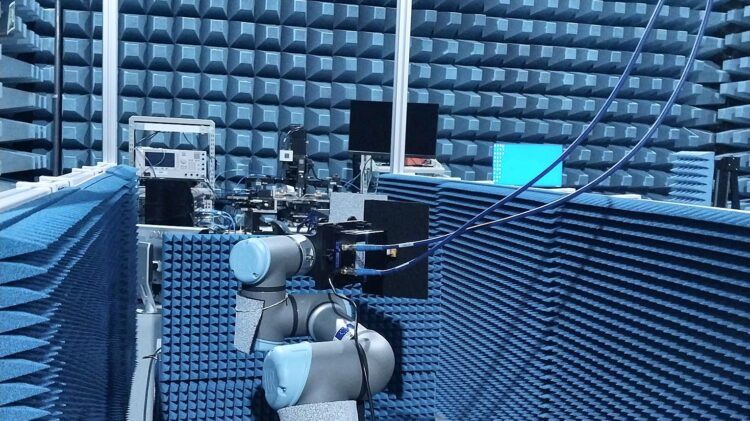
The radio frequency (RF) lab in Oulu uses a collaborative robot arm to scan antenna beam patterns. Its digital twin recreates the measurement procedure in software. Researchers plan the robot’s scanning paths there and check the alignment. They can spot any movement along those paths that could cause a collision or another anomaly before the hardware moves.
The team demonstrated the system operating at 145–220 GHz. The digital twin also helps the researchers assess how accurate a measurement is and study how the robot itself affects the antenna results.
“Our work demonstrates that developing and analysing a digital twin of the measurement system is essential for future 6G systems operating at high frequencies,” Leinonen says. “The twin lets us assess the measurement system, analyse its accuracy and reproducibility, and identify sources of error before any practical measurements are made.”
Lab covers frequencies up to 330 GHz
Beyond this study, the RF lab can characterise antennas from conventional wireless bands up to about 330 GHz. Most of its main measurement instruments come from Keysight, one of the 6G Flagship’s co-creators. The award-winning work also used frequency extenders from Virginia Diodes, a UR3 robot arm from Universal Robots, and RoboDK robot simulation software.
Husein was also one of three winners of the TICRA Travel Grant at AMTA 2026.
The research was funded by Business Finland‘s RF Sampo project, the 6G-XR project of the Smart Networks and Services Joint Undertaking under Horizon Europe, and the Research Council of Finland through the 6G Flagship.
More information
Professor Marko E. Leinonen
Radio Engineering, University of Oulu
marko.e.leinonen@oulu.fi