Resilience and 6G: friends or foes?
Two redundant network paths look identical on paper. Each fails 1% of the time. Ideally, chances that both of them fail together are 0.01%. But if they share a common power supply or a backhaul link and that fails, both links fail together, making their outage risk a hundredfold higher. The first lesson at the second 6G Resilience Summit was that until resilience can be measured, it cannot be designed.
Eduard Jorswieck of TU Braunschweig opened the technical talks with the outage example. Redundancy and resilience have a cost which belongs in the design calculation.
The 6G Resilience Summit 2026, organised by 6G Flagship in collaboration with Keysight Technologies and LUMI AI Factory, met in Helsinki on 27 October, where 20 experts discussed resilience from the physical layer to national preparedness.
“If connectivity can be made resilient in the demanding conditions of the North, it can be made resilient anywhere,” mused Matti Latva-aho, the University of Oulu’s Vice Rector for Research, opening the day.
Who depends on the network, and on what
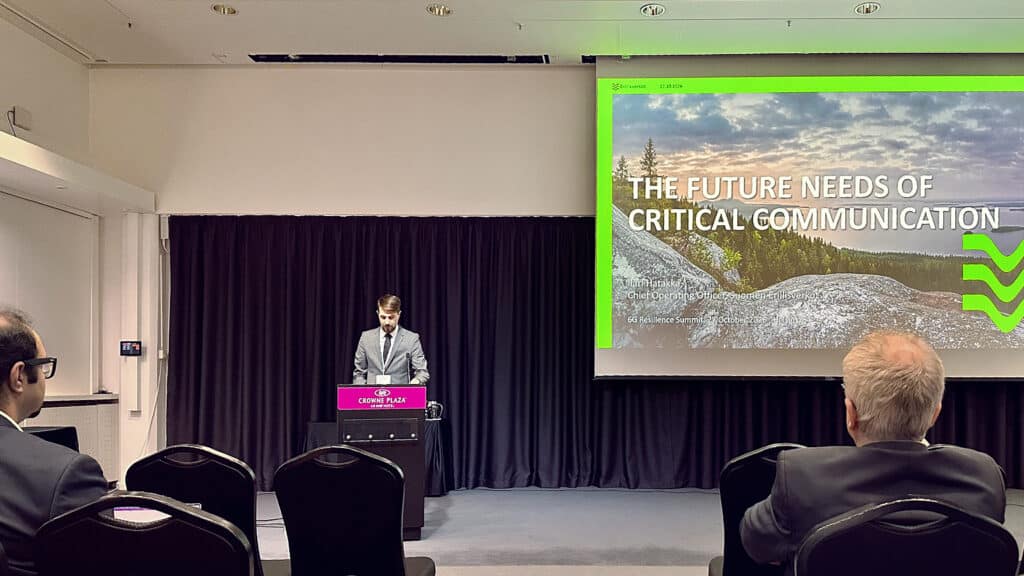
Ilari Hatakka, Chief Operating Officer of Erillisverkot, described the people who rely on Virve, Finland’s network for public safety, defence, and rail. Virve covers cities, forests, the sea, and the air, and serves more than 50,000 users. What they need, Hatakka argued, is a connection that is available, reliable, and usable. Availability rests on energy supply, deployable equipment, satellites, and direct links between devices. Reliability comes from priority rules, network slicing, and accessible robust terminals.
Janne Peisa of Ericsson widened the dependency. “Almost nothing runs fully locally any more,” he said. Every application, from passport renewals to the video on a phone, now rests on a connected stack of device, network, and cloud, and making that whole stack sovereign, connectivity included, is the real challenge. Where the data goes, said Jasmine Holmström of CSC, is itself a resilience question. She urged the room to work in such a way that the skills, data, and the know-how stay in Europe.
Falko Dressler of TU Berlin started with an anecdote from the 2021 floods in Germany’s Ahr valley, where first responders had to build networks from whatever infrastructure survived. Radios that share the same spectrum, such as Wi-Fi, LoRa, and LTE, cannot understand each other, so they rely on gateways that translate between them. Each gateway is just one more thing to fail. Dressler’s answer is to let devices talk to each other directly. His group has shown that radios that can fall back on each other’s language keep a link alive through jamming, fading, or a failed interface.
The measurement problem
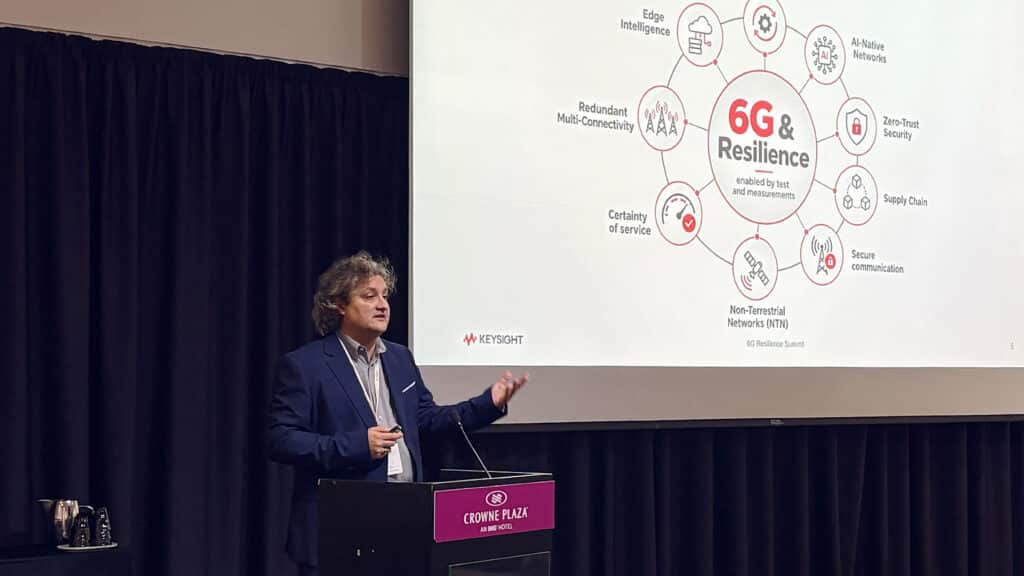
Michael Dieudonné of Keysight Technologies raised a problem with what digital twins are built from. Each component in a twin is represented by a model, and that model either predicts how the component ought to behave or records what it did under test. Measuring takes time. It also expires. His team has watched a handset’s energy consumption shift from one firmware release to the next, so every release means measuring again. The solution is data sharing. A vendor can hand a measured model to a partner without handing over the technology, which in a multi-vendor network is the only way anyone sees anyone else’s behaviour.
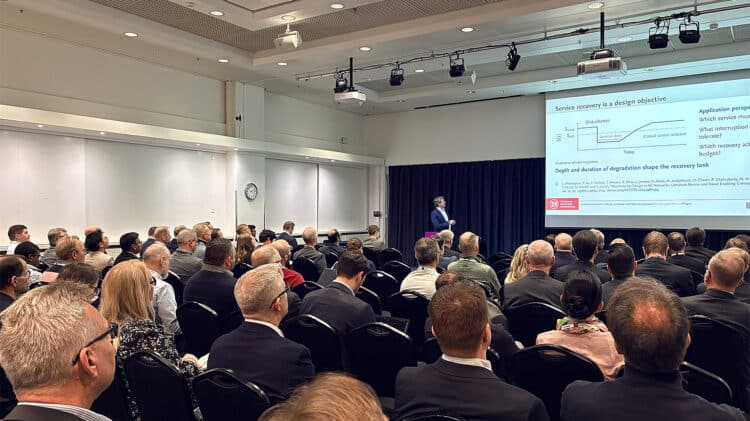
Everyone in telecommunications talks about resilience, and almost nobody measures it the same way, so no two results can be compared. That was Aydin Sezgin of Ruhr University Bochum, who works a level up, on the network as a whole. His group calls its metric the adaptation gap. You state the service you need, and the metric records how far the network falls short of it over time, scored separately for absorption, adaptation, and recovery.
Mikko Uusitalo, Head of Research Department Radio Systems Research Finland at Nokia Bell Labs, set out the loop resilience has to run in. Anticipate the threats, degrade gracefully when one arrives, recover, and feed what happened back into the anticipation stage. That last step needs a record of what the network actually did, which is what Nokia’s glass box work is for. “Redundancy is an input. Measured mission continuity is the outcome.”
Satellites, sovereignty, and the operator’s desk
Marko Höyhtyä of VTT and the National Defence University of Finland did the arithmetic on satellites. The European Space Agency expects around 100,000 satellites in orbit in the 2030s. At that scale satellites could serve a billion simultaneous broadband users, enough that a public safety operator no longer needs a second nationwide network as backup. The flip side is control. Military forces everywhere lean on commercial constellations that are not theirs. From Ukraine come two lessons for the terminal. Hide it from signals intelligence and thermal cameras, or make it so cheap that losing it on a one-way drone is barely a loss.
Bo Granbom of Saab described the defence problem that satellites feed into. Hypersonic missiles and drone swarms arriving all at once are Ukraine’s daily reality. No single system can cope with them. His answer is multi-domain orchestration across air, land, sea, cyber, and space, built so that losing any one sensor, link, or command post does not bring the whole system down. He added a sixth domain, civilian society, which makes the resilience of civilian networks a defence question too.
Bo Granbom, who orchestrates a multi-operator network in a crisis?
Hakima Chaouchi, France’s 6G coordinator, linked digital sovereignty to resilience. Sovereignty rests on data, infrastructure, and regulation. A country that runs on someone else’s cloud depends on someone else’s decisions in a crisis. Finland starts from a strong position, she said. Nextcloud’s Digital Sovereignty Index, which counts self-hosted collaboration servers, ranks Finland first in Europe.
Tomi Liesimaa, Cyber Security Manager at DNA, spoke for the operators. Their starting point is to assume the network has already been breached. If someone manipulates the data an AI learns from, it starts making harmful decisions. Can we stop it? Is there a kill switch? Those questions belong in the design.
The panel: friends or foes
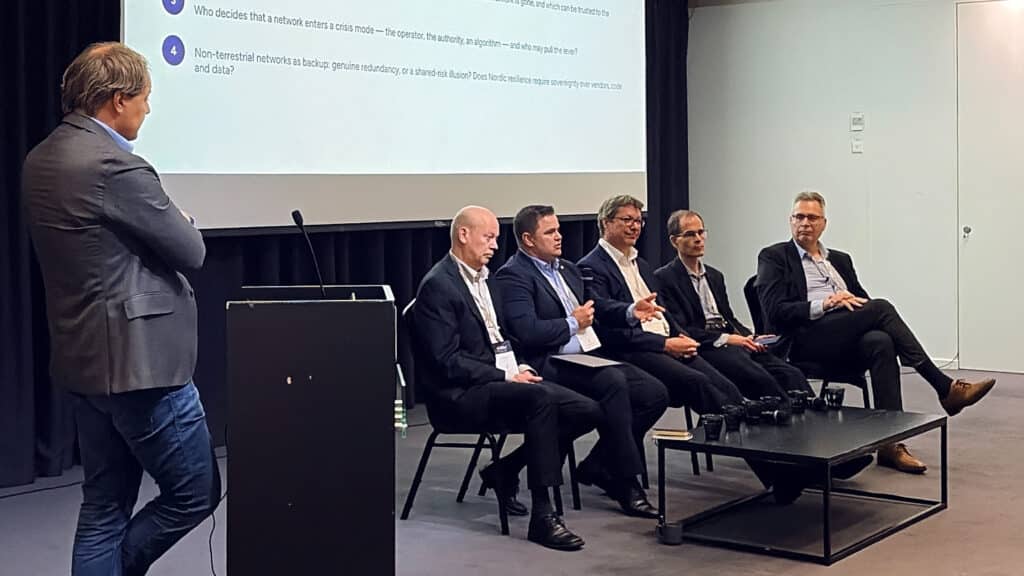
James Gross of KTH asked five panellists whether resilience and 6G are friends or foes. Hirley Alves of the University of Oulu said efficiency and resilience have been enemies because resilience needs slack, and slack looks like waste. Jorswieck asked whether resilience, which includes degradation and recovery over time, can be given an objective function of its own, as capacity and reliability were. Tero Pesonen, Chair of the Board of TCCA, said mission-critical users may number 0.1 billion against eight billion consumers, but by 2040 everyone will need what they need today.
Jari Partanen of Bittium argued from the tactical side. AI is a resource for 6G, he said, but also a weapon for the attacker. A security chief he knows saw an exploit built with AI less than two days after the flaw was found. A network that relies on fixing flaws after they appear will not keep pace.
Uusitalo placed resilience in the standards timeline. The first 6G release names security and resilience alongside performance, sustainability, and AI, so it is on the map from the get-go. The harder question is who pays. Resilience features sit unused most of the time. Their benefit reaches far beyond the operators who fund them. Speaking as a private citizen, he asked whether society should cover part of the cost. The panel agreed on one thing before Ari Pouttu, Director of 6G Flagship, closed the day. Resilience will become a design objective once it can be measured. Nobody on stage claimed it could be yet.
Available slides
Some speakers’ slides are available at the 6G Resilience Summit website.