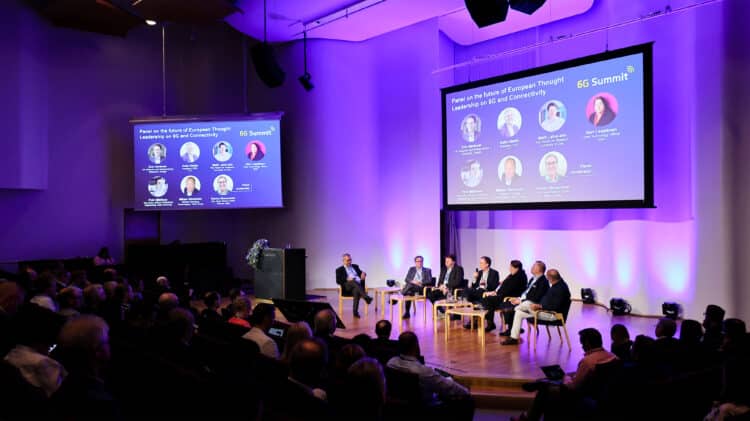
6G is coming sooner than planned, industry tells Helsinki summit
Finland’s eight-year 6G research effort reported its results at the 6G Summit in Helsinki on Wednesday 28 October, and heard from industry that the technology is arriving sooner than it had planned for.
Two years ago, Mosaab Abughalib, General Manager and Head of the Wireless Solutions Group at Keysight Technologies, would have put the first commercial 6G networks at 2030 or 2031, and he now expects them in 2029. The industry wants to show 6G at the Los Angeles Olympics in 2028, which means new chipsets and prototype networks in 2027. “2027 is only two months away,” he told Finlandia Hall.
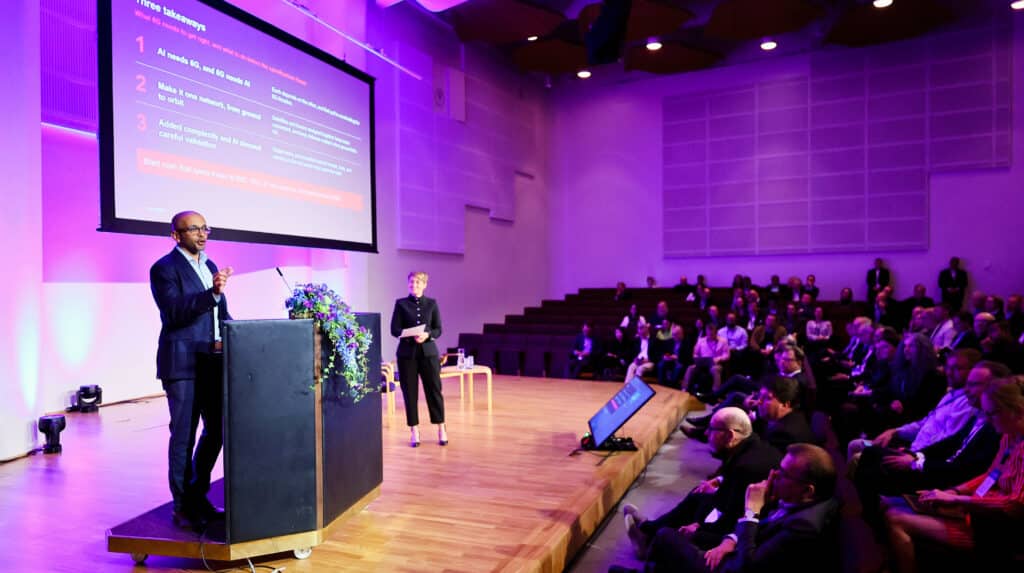
Justin Hotard, President and CEO of Nokia, explained why 6G cannot simply repeat the last two generations. In the developed world, he said, operators earned below their cost of capital on 4G and again on 5G, and the vendors did no better. “Going to the next phase on the same path makes no sense.” Almost everything in use today runs on a 4G network. What 6G has to carry is physical AI, sensing, and compute delivered where it is needed, and that takes a different architecture.
What eight years of 6G research funding produced
The summit, organised by Business Finland’s 6G Bridge programme and the University of Oulu’s 6G Flagship, came at the end of the Research Council of Finland’s eight years of flagship funding. Petri Peltonen, Under-Secretary of State at the Ministry of Economic Affairs and Employment, opened the day. 6G, he said, “is no longer just about faster mobile broadband or higher data rates” but “deep convergence” of wireless networks and artificial intelligence, and Finland, the EU, and the United States share a strategic interest in keeping that infrastructure open, secure, and resilient.
Matti Latva-aho, Vice Rector for Research at the University of Oulu and the programme’s first director, spoke next. Planning for 6G Flagship began in 2017, he recalled, before the 5G standard was complete.
“Looking back, we really did what we set out to do.”
Matti Latva-aho, Vice Rector for Research, University of Oulu
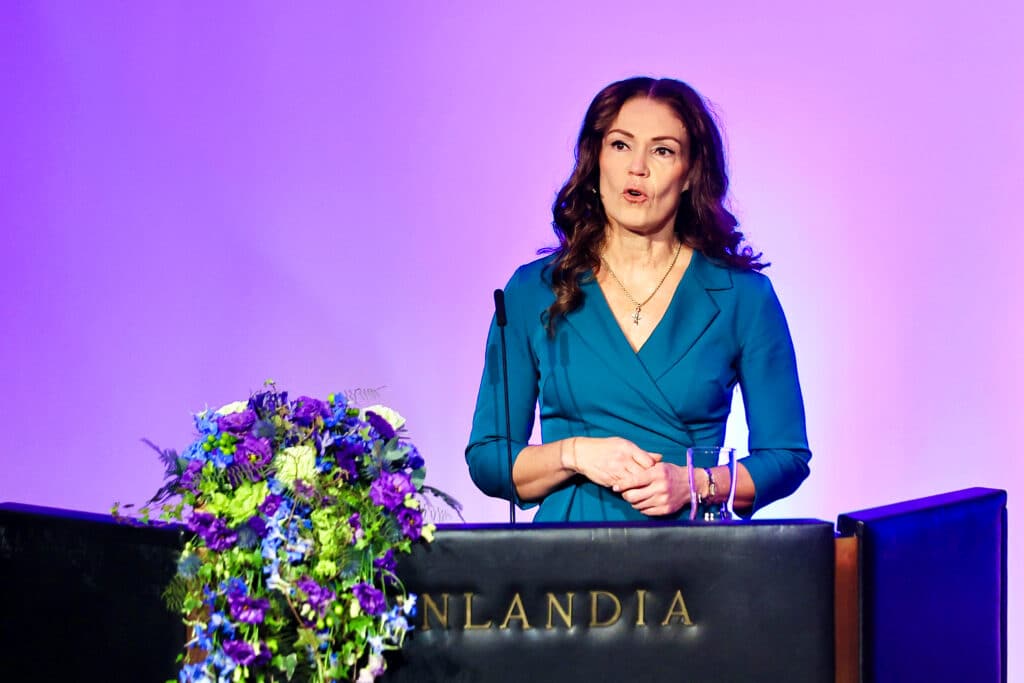
Lulu Ranne, Minister of Transport and Communications, placed 6G inside a harder frame. Technology, she said, now sits at the core of foreign and security policy, and the engineers in the hall, “the superheroes”, should aim higher than the roadmap so far allows. “Nothing average, nothing … enough.” On the EU, her request was consistency, the same rules for everyone, so that Finland and its partners compete on a level playing field.
Europe and the United States fund the same race. Erzsébet Fitori, Executive Director of the EU’s Smart Networks and Services Joint Undertaking, expects commercial 6G deployment around 2030; the final SNS JU call under Horizon Europe opens in January 2027 with about 220 million euros. The US National Science Foundation is investing more than 110 million dollars in 49 projects under its new VINES programme, Verticals-enabling Intelligent Network Systems, five of them bilateral Finnish and US teams, in partnership with Business Finland and the Research Council of Finland.
Nokia and NVIDIA on their AI-RAN partnership
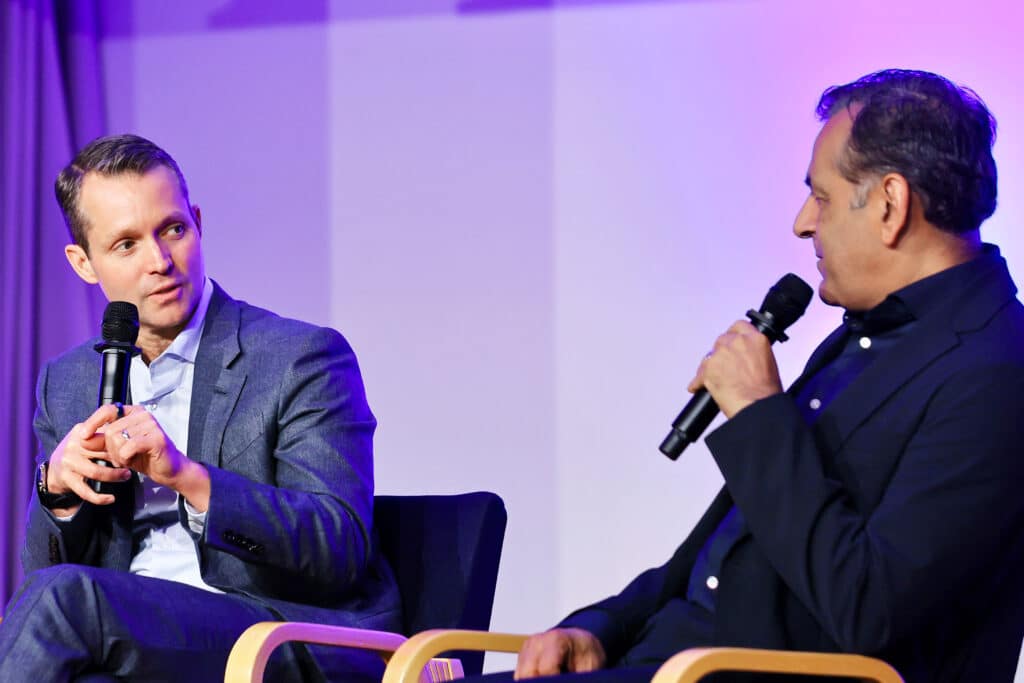
Nokia and NVIDIA announced their AI-RAN partnership a year ago. At the Summit, Hotard and Ronnie Vasishta, NVIDIA’s Senior Vice President for Telecoms, reported on what it has produced so far. Nokia’s AI-RAN platform, launched in July, targets more than 100 per cent spectral efficiency gain by 2028, and on 21 October the two made the first AI-RAN call on a live network, with T-Mobile in Bellevue, Washington. The call came two months early, Hotard said, and against a published 20 per cent gain in live trials, the lab now shows 25 to 30. “My team will say 25 officially, but it’s really 30.”
Radio access networks have run on proprietary chips, Vasishta said, because general-purpose processors could not keep up with the demands of the radio. Accelerated compute, the same hardware that runs AI, now can. A base station on that hardware becomes software, and gains performance with each update rather than waiting a generation to be replaced. “There’s never been a better time to be in telecoms.”
Hotard argued against regulating AI-native networks before they exist. “You will absolutely regulate the wrong thing, because it hasn’t been built yet and we don’t know what to regulate,” he said, and the second cost would be slowing down while “adversaries on the other side are not slowing down”. His alternative was to enforce the laws already in place, work with trusted partners, and keep each operator in control of the AI models running in its network.
Latva-aho reminded the two: “Eight years back, when we were starting the 6G Flagship programme, we talked a lot about sustainability … about energy efficiency of future networks. Now we are talking about software-defined networking with GPUs.” How did they see that discussion now? “From an energy efficiency perspective, you have to go to accelerated compute,” said Vasishta. “You can’t run AI purely on a CPU. It will be hugely energy inefficient.” Hotard saw a trap on the other side. “We can be incredibly energy efficient and not build anything. That is not a good answer for the human race. But it’s an answer.”
Would universities, “not best known for being fast”, still be needed when innovation moves at this pace? Vasishta replied to the concerned researcher: “Universities will not just survive, they will thrive.” Hotard said the move to AI-native networks makes universities “even more relevant”.
Nokia is refocusing Bell Labs on that future by aligning it with university research, including at Oulu and Aalto. “We look at what NVIDIA has done, and we think that’s the right model.”
Space as part of the radio access network
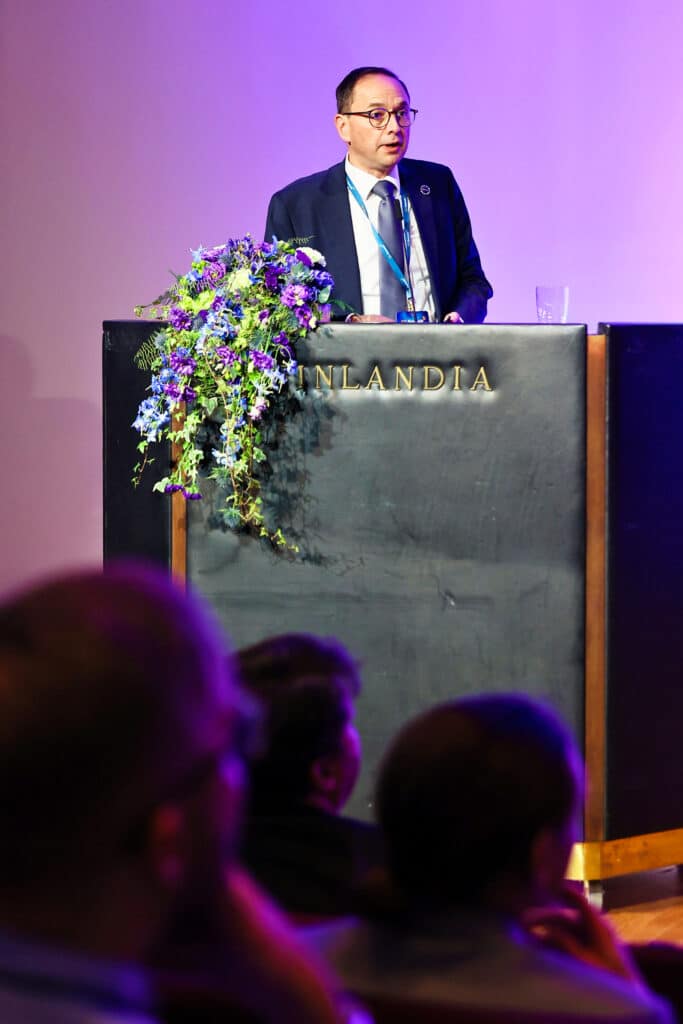
Laurent Jaffart, Director of Resilience, Navigation and Connectivity at the European Space Agency, opened the afternoon with an architecture question. “Will 6G predominantly remain terrestrial, or will it be designed from the beginning as a network encompassing Earth and space? As you can imagine, from the European Space Agency the answer is clear. Non-terrestrial networks must be native components of 6G.”
Satellites have so far been treated “as a separate network, or as backhauling for locations beyond footprint”, he said. With 6G, non-terrestrial networks, or NTN, become “part of the radio access itself”, and the base station moves on board the satellite. He closed by setting out the stakes. “Without non-terrestrial networks, 6G will not be global. Without resilience, it will not be trusted. Without sovereignty, Europe will not shape it.”
Who pays for 6G?
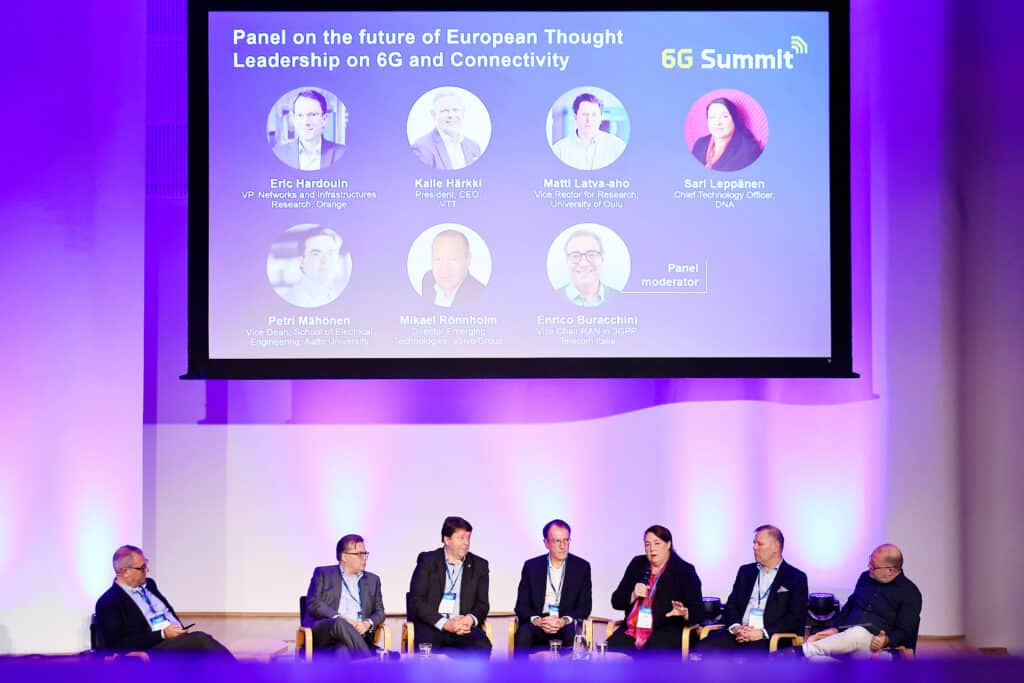
Enrico Buracchini, 5G/6G Senior Project Manager at Telecom Italia and Vice Chair of the 3GPP RAN plenary, moderated a panel of two operators, two universities, VTT, and one vertical. Mikael Rönnholm, Director of Emerging Technologies at Volvo Group, said his company cares about capability, quality, and cost. “If our results can be delivered by 3G or 4G or 5G or 6G or smoke signals, we don’t care.” 5G had promised a lot to industry and delivered little, he said, and 6G should be developed with the verticals rather than delivered to them.
Eric Hardouin, Vice President for Networks and Infrastructures Research at Orange, made the same point from the operator side. The one certainty in 6G, he said, is cheaper capacity in the 6 to 7 GHz band. Every new revenue stream, from sensing to AI quality of service to satellites, is unproven. Sari Leppänen, Chief Technology Officer of DNA, had the highest expectations on the panel, with industrial customers first in line, but on one condition. “We always do technology, and then we put it on the shelf to wait for somebody.” From now on, “the business has to be minimum 60 per cent of the discussion”.
What the state’s 6G funding produced
Jukka Tanskanen, Head of Science Policy and International Affairs at the Research Council of Finland, recalled that 6G Flagship was the first project chosen in the Council’s Flagship Programme in 2018, ranked first on science among 49 proposals. The programme has since granted 240 to 250 million euros to 14 flagships.
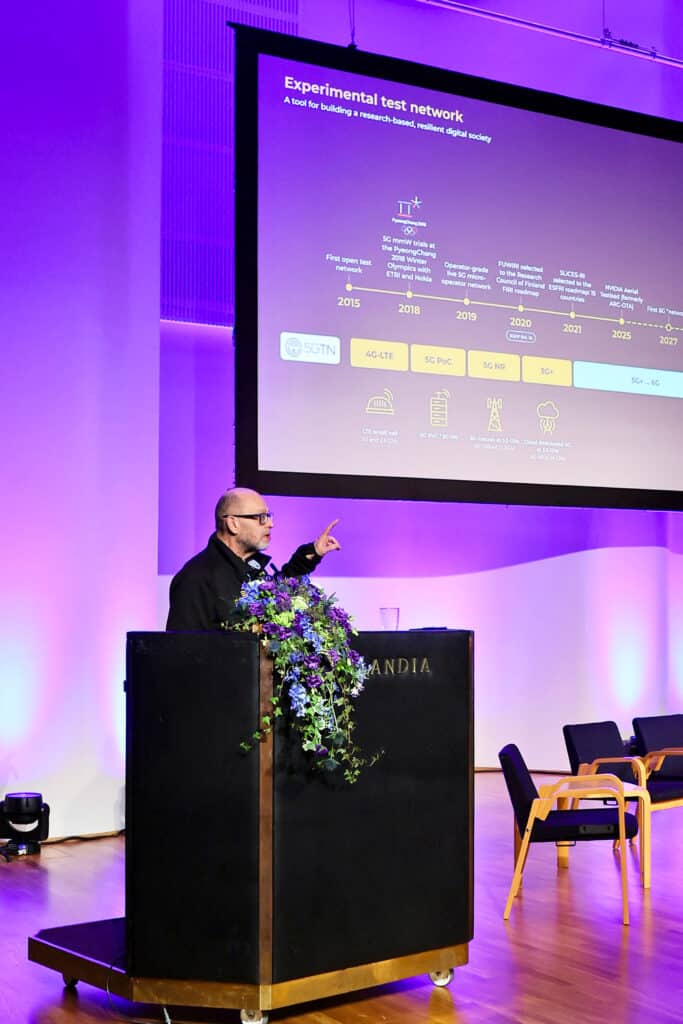
Ari Pouttu, Director of 6G Flagship, began with the year there was not supposed to be a 6G at all. “In 2018, industry experts and the Commission representative said no, there will not be a 6G,” he said. The programme convened the first 6G Summit in Levi in 2019 and launched the first 6G white paper there. “After the Levi Summit, it started to look like there would actually be a 6G.”
Eight years on, the programme has produced 4,875 peer-reviewed publications, a quarter of them in the world’s top 10 per cent most cited, and 188 doctoral degrees, three quarters of the graduates now working in Finland. It has run 597 externally funded projects with 458 company collaborators, 145 of which fund the research, and those companies count 902 jobs created in Finland as a result. Research Council funding of about 20 million euros sat inside a programme worth 238 million euros in direct funding, or 281 million once in-kind contributions are counted.
“Being a flagship has generated more than ten times the funding that the flagship funding itself provided.”
Professor Ari Pouttu, Director, 6G Flagship
6G Flagship continues on University of Oulu funding, he said, at least until the 6G standard is ready in 2028, and possibly to 2030. Next year the Oulu test network will run what he called the first 6G network, on 6 to 7 GHz frequencies with 6G antennas and a 5G waveform.
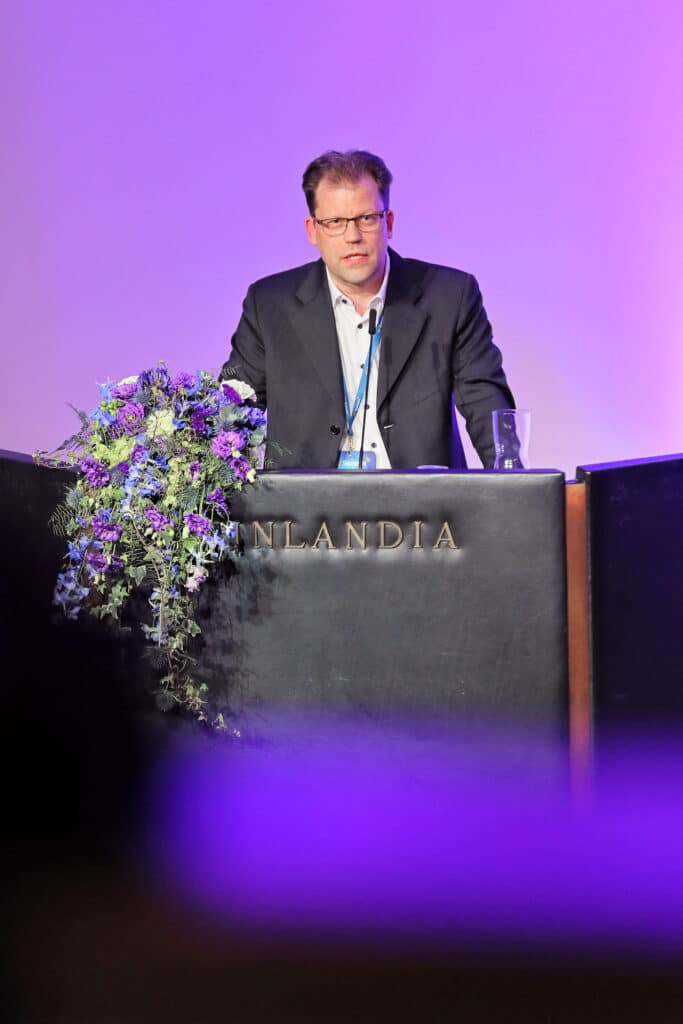
Pekka Rantala, Head of the 6G Bridge programme at Business Finland, closed the day. His programme has funded about 60 projects with 120 million euros and drawn in some 1,000 organisations. One of his lessons from it was about money. “The hardest 6G questions are business questions. Who pays? Who benefits? And who captures the value?” Industry needs “credible commercial answers, not just compelling demonstrations”, he said. Another was shorter. “Ask not only what the network can deliver, but what difference it makes.”
Recordings of the Summit talks are added to the 6G Summit 2026 playlist on YouTube as they are published.