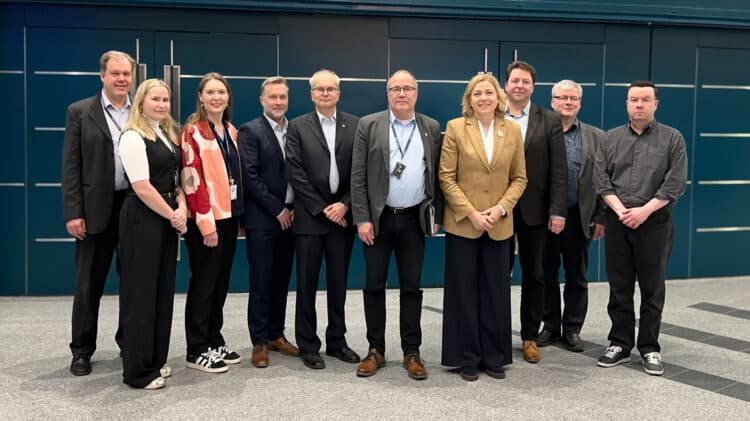
Henna Virkkunen visited University of Oulu to discuss 6G research and tech sovereignty
On 23 April 2026, Henna Virkkunen, Executive Vice-President of the European Commission responsible for Tech Sovereignty, Security and Democracy, was welcomed to the University of Oulu by Rector Arto Maaninen to meet the team behind Finland’s 6G Flagship programme. The agenda covered standardisation, spectrum policy, defence applications, chip design, longer-term research goals and monetisation of research for the benefit of the EU area.
The 6G international standard is expected by the end of 2028, and the work shaping it is well underway. Professor Matti Latva-aho, Vice Rector for Research at the University of Oulu and former Director of 6G Flagship, opened with a summary of eight years of work. The programme now involves roughly 600 researchers, has completed more than 60 EU projects, and has produced fifteen independently published position papers that have shaped global research agendas. Finland’s contributions to the ITU’s IMT-2030 process, the global-level definition of what 6G should be, pushed sustainability, resilience, and security onto the agenda in forums where commercial interests tend to dominate.
“Academic actors are neutral in a way that companies cannot be,” Latva-aho said. “Companies have their own interests. We can take a broader view.”
Professor Markku Juntti, Wireless Connectivity Lead at 6G Flagship, described how future networks can function as sensing and detection platforms using their own radio signals, without additional hardware. The defence applications are concrete. 6G networks may be useful in addressing drone detection and similar public security concerns. Virkkunen confirmed the Commission’s drone and anti-drone action plan is looking at exactly this. “We want to bring together member states, the Union, and companies in this area,” she said.
The path from research to regulation is rarely straight, and few know its bends better than Dr Marja Matinmikko-Blue, Director of Sustainability and Regulation at 6G Flagship. The Commission’s December 2025 harmonisation decision on the 3.8–4.2 GHz band, and the parts of draft Digital Networks Act, both trace back to research work done in Oulu, channelled through the Radio Spectrum Policy Group. Large operators frequently resist changes that complicate existing business models. “It’s a fight sometimes,” Matinmikko-Blue said. “But there is a role for us.”
Professor Jaakko Sauvola, Ecosystem Director at 6G Flagship and Co-Chairman of 6G Finland, highlighted the unique structure of Finland’s 6G setup that connects research, funding, and industry. 6G Finland is responsible for national strategy work and, together with 6G Flagship, has brought together more than 1,200 partners nationally and internationally. As 6G technology matures, the funding model must mature alongside it. This requires an additional funding instrument on top of broad research programmes to enable solution-level investments with a clear path to market. “Finland already has all the pieces: the technology, the test environment, the platform, and the vision,” he said. “Through our continuous strategy work, we know what the market needs. Now we need the right funding instrument to support it.”
Hannu Nikurautio, Research Director of the 6G Test Centre, outlined how the Centre serves NATO DIANA innovators and dual-use customers across secure connectivity, autonomous systems, and Arctic testing, with a validation chain running from lab conditions through to operational field deployment. Since opening to external users in 2025, the centre has built a growing portfolio of DIANA and dual-use projects. Dean Jukka Riekki added that a five-million-euro Northern Programme investment, routed through the Ministry of Defence, routed through the Ministry of Defence, is developing the Centre further, with a NATO Innovation Range demonstration planned for Oulu in October 2026.
Europe’s ambitions in 6G, and in the semiconductors that will run it, face a common constraint: a shortage of trained chip designers. Professor Marko E. Leinonen, on behalf of Prof. Aarno Pärssinen, Devices and Circuit Technology theme leader at 6G Flagship, noted that the number of circuit designers in Europe needs to at least triple within coming years to keep up in European 20% global market share target and that a doctoral degree is the field’s entry-level qualification. Universities in Oulu, Tampere, and Helsinki are collaborating in a joint doctoral pilot programme as a first step to address the gap— an initiative Virkkunen suggested EU funding instruments should be able to support, given that AI, quantum, and semiconductors are among the Commission’s explicitly named critical technology priorities.
The sharpest exchange of the day came on a concern Matinmikko-Blue has watched grow alongside the programme’s success. In large EU projects with significant industry involvement, companies are beginning to dictate research directions. “This is not a good situation,” she said. Virkkunen replied without hesitation: “If business interests start restricting research freedom, it is damaging for our research in the long run.”
Reflecting on the visit in a LinkedIn post, Virkkunen described 6G Flagship as one of the world’s most cited 6G research initiatives. “Europe has what it takes: world-class research, strong industrial ecosystems, and globally competitive talent,” she wrote. “Now we must connect these strengths, scale them at the industrial level, and build the demand that anchors production in Europe.”