Beamforming for networks that sense and communicate at once
There is something elegant about using the same signal to both talk and listen. A single transmission carries data and, simultaneously, maps the surrounding environment. The problem is not the concept. It is the maths required to make it work fast enough to be useful.
High-frequency bands and massive antenna arrays deliver the throughput and sensing resolution that 6G demands. But they come at a cost. The more capable the hardware, the heavier the signal processing burden, and beamformers that must serve both communication and sensing simultaneously are particularly expensive to compute. Real-time operation starts to look like an unrealistic ask.
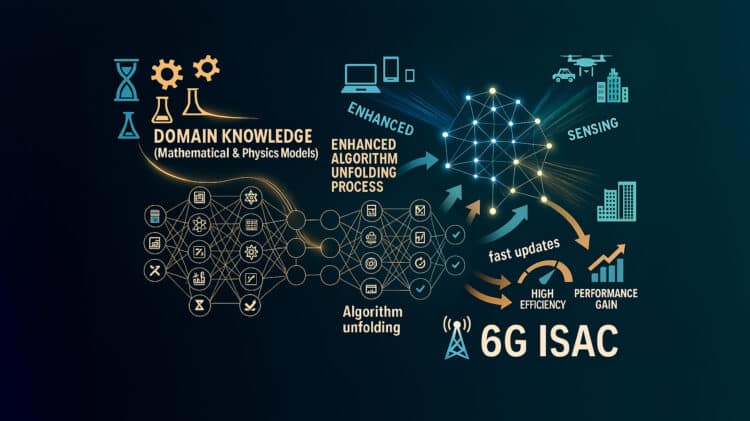
Model-based machine learning offers a way through. Purely data-driven networks can struggle to generalise across the fast-changing conditions of wireless environments. By folding domain knowledge directly into the learning architecture, model-based methods avoid that brittleness. The result is a system that can adapt from data without abandoning the mathematical structure that makes wireless algorithms reliable and interpretable.
A central technique here is deep unfolding. Rather than treating beamforming as a black-box learning problem, it converts each iteration of a classical optimisation algorithm into a trainable neural network layer. The network behaves like the original algorithm but learns improved update rules from data, converging faster and with greater reliability.
In our recent paper in the IEEE Journal of Selected Topics in Signal Processing, we found that the analogue and digital components of a hybrid beamformer naturally operate on different timescales. That asymmetry turned out to be useful. It suggested a nested architecture where the analogue precoder is refined through multiple inner layers while the digital precoder evolves across outer layers, each component updated at the pace that suits it.
The layered structure mirrors classical alternating optimisation and projected gradient ascent. What changes is that step sizes and update rules are learned rather than fixed, which is where the speed gains come from. The algorithm’s underlying logic remains intact.
The deep unfolded solution achieves higher communication rates and more accurate sensing beam patterns than conventional optimisation techniques. It also converges significantly faster, which matters as much as the accuracy gains for any system that needs to operate in real time.
That combination of accuracy, speed, and manageable complexity is what makes the approach worth taking seriously beyond the lab. Systems that perform well only under idealised conditions are not useful. These results suggest the method can hold up in the kinds of large-scale, resource-constrained deployments that 6G will actually require.
Deep unfolding is not a universal fix, but it illustrates something worth paying attention to: that embedding domain knowledge into a learning architecture tends to produce better results than discarding it. As 6G research matures, that principle is likely to matter more, not less. The gap between what these systems can do in simulation and what they can deliver in deployment is still the hard problem. Work like this narrows it.
Read our article Joint Communications and Sensing Hybrid Beamforming Design via Deep Unfolding.
About the author
