6G Test Centre shows companies the route from laboratory to field trials
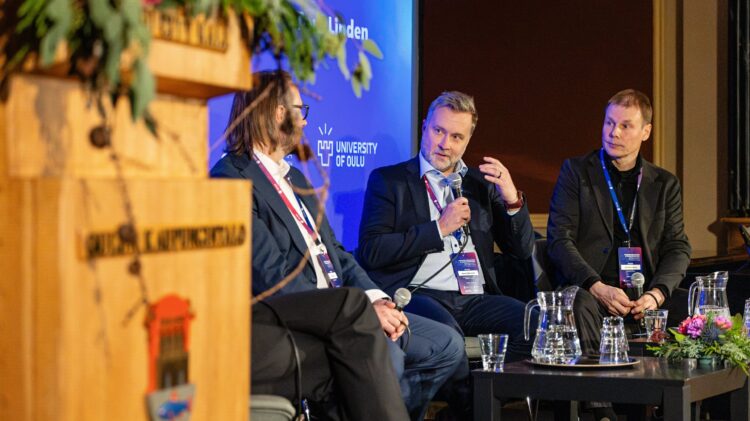
Companies building communications technology for defence must show that it works outside the laboratory. At the Northern Security and Economy Forum in Oulu on 11 November, Hannu Nikurautio, Director of the University of Oulu’s 6G Test Centre, described how the Centre takes them from the first lab test to field trials.
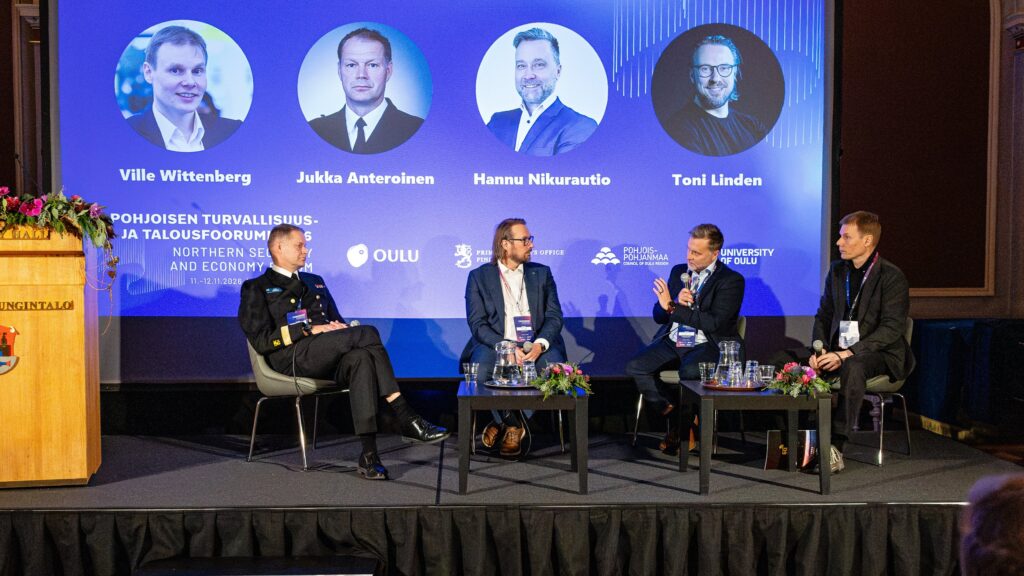
Nikurautio, who leads one of the test centres of NATO’s Defence Innovation Accelerator for the North Atlantic (DIANA), spoke on the panel “From 6G to Defence Capability: Building the Northern Innovation Advantage”. Commodore Jukka Anteroinen, Chief of Planning in the Finnish Defence Forces, and Toni Lindén, CEO of KNL Networks, joined him on stage. Ville Wittenberg of 6G Flagship moderated the discussion.
Testing moves from the laboratory to the field
Nikurautio said the Centre works directly with companies, both from the Oulu ecosystem and from other NATO countries, and guides them through testing and integration. “We help the companies with their journey,” he said. Its researchers also look for new results that could help those companies.
Every project starts from what the customer needs and how mature the technology is. In the laboratory, a test can be repeated until the product improves. Next comes system-level testing in the Centre’s test network, a hybrid network where a company can show that its solution works as part of a larger whole. The last stage is the field, where weather and the surrounding environment affect performance.
For that stage, companies use Base Aurora, a test environment in Oulu for drones, autonomous systems, radio technology, and advanced connectivity. The test network lets the team build demonstrations there quickly, Nikurautio said, and the site holds wide permits for drone flights. Earlier this year, researchers from the University of Tokyo tested a drone-mounted 5G base station there, a radio trial Japan’s regulations do not yet allow.
A project with the Ministry of Defence aims to give the site permanent network infrastructure. “We don’t need to always spend half a year to plan it or build it,” Nikurautio said. The ministry has awarded €4.8 million to the programme, which a consortium of the University of Oulu, VTT, Nokia Defense, and Telia delivers.
Solutions that pass the field demonstrations can go on to live experiments run by the Defence Forces. There, users judge whether a technology is mature enough for their needs.
Demonstrations show how companies’ technologies fit together
Oulu already has expertise along the whole technology chain, Nikurautio said, from sensors and hybrid networks to sensor fusion, artificial intelligence, edge computing, and command and control systems. Many of these capabilities have already been integrated and demonstrated at Base Aurora, including at the NATO Innovation Range Capability Demonstrator in late October, where the Test Centre ran a joint demonstration of a hybrid network.
The next step is to bring the right audiences to see them. Demonstrations work best, in his view, when operational users, decision-makers, and potential customers can see at first hand how technologies from different companies work together, and what each adds to the whole system.
Defence sets a different bar for reliability
“I think the tech part is easy,” said Lindén. Companies that grow out of research often overlook how complex it is to turn technology into a product, he said. A product has to be tested and proven in the field, and it needs everything around it, from lifecycle management to training.
Lindén, a former officer himself, said such test facilities do not exist in Central Europe. “It’s essential for companies to be able to test in the field, because the reliability requirements for defence use are at a totally different level than for commercial use,” he said.
Finland should build on communications, Commodore says
Anteroinen said Finland cannot lead Europe in every area of dual-use technology, meaning technology with both civilian and military uses. Communications has long been one of its strongest niches. He cited Finland’s part in the European ESSOR software-defined radio programme, which led to a national software-defined radio that the Defence Forces have since procured. He also cited Finland’s two NATO DIANA test centres, the one in Oulu and another in Espoo that tests cyber-secure communication and quantum and space technologies.
“If you want to be world class in some area, you should not improve your weaknesses. You have to improve and strengthen your strengths,” he said. In his view, 6G is one of those areas.
Anteroinen also pointed to an information gap between the armed forces and industry. “We know what we need, they know how to do it.” Dialogue between the two, he added, can always improve.
Asked for one wish, Nikurautio said he already sees many proven technologies, and users who need them. “I would like to see them getting into business faster,” he said.
The Prime Minister’s Office, the City of Oulu, the Council of Oulu Region, and the University of Oulu organised the forum at Oulu City Hall on 11 and 12 November.
The 6G Test Centre is part of the University of Oulu’s 6G Flagship research programme. Companies can find information on its testing services and research partnerships at 6gtc.com.