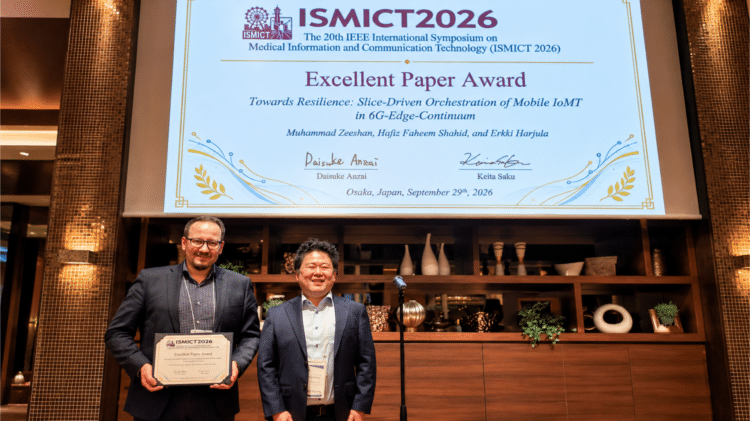
6G medical IoT paper wins Excellent Paper Award in Osaka
A paper on keeping medical Internet of Things (IoMT) services running while patients and devices move through a 6G network has received an Excellent Paper Award at ISMICT 2026. The 20th IEEE International Symposium on Medical Information and Communication Technology took place in Osaka, Japan, from 28 to 30 September. The conference gave one Best Paper Award and one Excellent Paper Award in its main category, with the same two awards in a separate student category. The paper was eligible for the student category but competed in the main one.
The paper, “Towards Resilience: Slice-Driven Orchestration of Mobile IoMT in 6G-Edge-Continuum”, was written by Muhammad Zeeshan, doctoral researcher Hafiz Faheem Shahid and Erkki Harjula, tenure-track Associate Professor at the University of Oulu’s Centre for Wireless Communications. The paper is based on Zeeshan’s master’s thesis at the University of Oulu. Harjula presented it at the symposium.
Medical IoT encompasses connected devices used in healthcare, from wearable sensors to remote doctor consultations and surgery supported by extended reality (XR). These use cases place different demands on the network. A surgical video feed can’t tolerate delay, while a wearable sends little data but may share the network with thousands of other devices.
“Critical healthcare services shouldn’t be affected by patient’s movement. Traditional 5G network slicing ensures only sufficient network capacity in mobile scenarios. Our proposal goes beyond that by including the sufficiency of computing resources in the same optimization problem.”
Erkki Harjula, University of Oulu
The paper treats two decisions as one problem. The first is which network slice a service should use. Slicing divides a single physical network into virtual networks tuned for different needs. The second is where the computing should run. Sending everything to a distant cloud depends on a reliable connection and adds delay, so the work is performed, whenever possible, at edge nodes, computing resources placed at base stations close to the user. These nodes vary in processing power, memory and storage.
In the proposed system, a central orchestrator reads each service’s needs for latency, bandwidth, and computing power, assigns a slice, and checks the capacity of nearby base stations. It then deploys the service, redirects it to another base station if the first is overloaded, or rejects it when no resources are free. When the user moves, the task is handed off to the next base station so the session can continue.
In simulations with 500 users, the framework accepted 97 per cent of service requests, against 47 per cent for a baseline method. Blocked requests fell from 53 to 3 per cent, and bandwidth use dropped by about 40 per cent.
Harjula leads the WEALTH research team in the Centre for Wireless Communications research unit (CWC) at the University of Oulu, where his work focuses on communication architectures for digital healthcare.
The paper
Towards Resilience: Slice-Driven Orchestration of Mobile IoMT in 6G-Edge-Continuum
Muhammad Zeeshan, Hafiz Faheem Shahid and Erkki Harjula
Excellent Paper Award, ISMICT 2026, Osaka, Japan
To be published in the ISMICT 2026 proceedings in IEEE Xplore.